
Do You Believe in Magic?
Updated: May 7
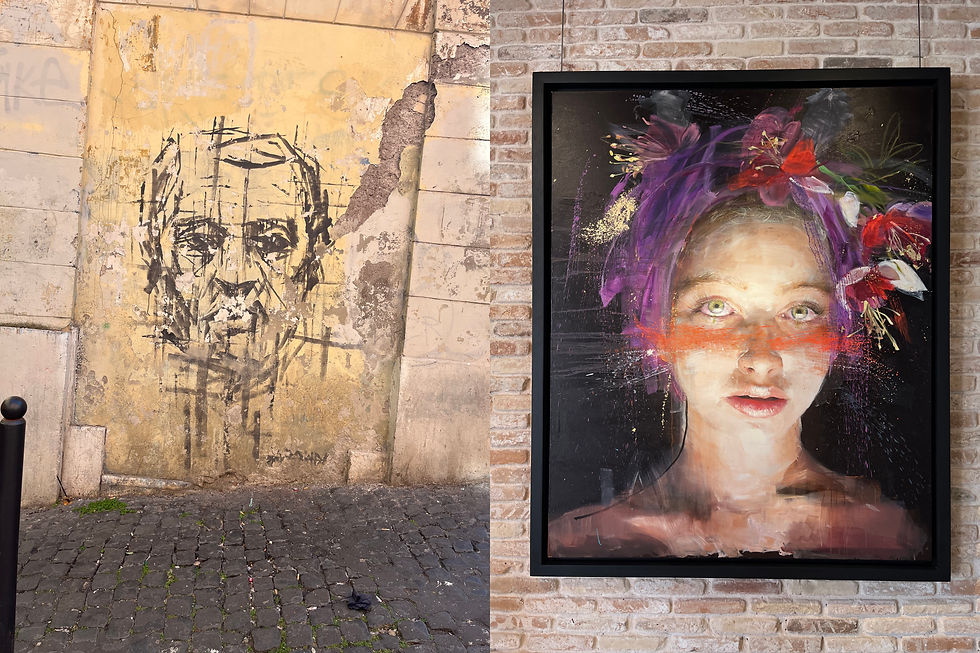
These two portraits are roughly the same size, six feet square. Gonzalo Borondo did the mural (left) on a wall in Rome about fifteen years ago, when he was still scrapping around as a street artist. Roberta Coni's painting (right) is displayed in a gallery in Venice alongside original works by Salvador Dali.
I first saw the Borondo on a street art website years ago. His ability to express so much humanity with a few slashing brushstrokes captured me. I am in awe of power like this, and I felt starstruck when I saw it in person last week.
Similarly, Coni's painting stopped me in my tracks, first holding my gaze, and then my heart. The gallerist explained that the model was receiving cancer treatments, which explained the hint of nosebleed, the hidden hair, the searching eyes.
One of these portraits was done in minutes on a side street. By some measures, its presence is a crime. By mine, it's a gift.
The other carries a price tag of 40,000 Euros*.
My intention here is not to compare these pieces; to me, each is a master work in its own way. Rarely does an artwork reach into my soul, but these two do. They create moments of focus; spiritual prisms so sharp that all the colors of humanity seem to flow through them, and by extension, through us.
A few faded lines on a crumbling Roman wall.
Layers of paint and random bits of glitter on a canvas.
Human moments; bold expressions by living beings. It doesn't take much to animate our spirits, but it does take life, soul, anima. The presence of another person at the origin of the thing we experience. The confidence that what is being said is worth saying. Perhaps, too, the fear that it will not be understood.
That we will not be understood.
There is a vulnerability in sincere human expression that no machine can ever replicate. There is a singular, genuine note played by the human soul when it reaches out through creativity to touch another one.
I listen for this in my work with kids. When they finally trust the moment and the process and write truthfully, there is power in their sincerity. It is a delicate thing, so easily crushed by commercial counselors intent on packaging young lives for institutional approval, or by A.I. editors that smooth away the humanity of their writing.
To me, the word 'art' has always meant 'process' and not 'product.' Commerce corrupts that process. A high-dollar sale may be the natural result of worthy work, but it cannot be the genesis of it. Souls do not speak the language of sales.
Too often, those with no understanding of the process of a human spirit expressing itself creatively are allowed to render judgment of its worth. I do not need to spell out the ways in which this mentality has distorted our society's values; it's all around us.
I am not so naive as to say that transactions don't matter; those who wish to succeed in the American economy do at some point need to establish their value to it. The ones who hold the power of the purse—or the college admission—dictate the terms of those transactions. So be it.
But that's not where the magic lives.
Borondo dashed off a portrait and then fled the Carabinieri. Coni saw and felt one vulnerable girl's battle with cancer, and celebrated her. And honestly, very few people noticed. Most of the passersby I saw around these pieces were nose-deep in their phones.
So be it.
Every moment of every day cannot be magical. But unless you know where to look for it, around you and within you, you will miss the magic when it's there. It's not in the net worth generated by the latest internet influenza. Sometimes it's right next to you on a shabby, crumbling wall.
(* For kicks, I negotiated with the Venetian salesman and got the price of Coni's painting down to around 32,000 Euros— including shipping—then admitted that I don't even have a wall big enough for it, let alone that kind of jack.)

